
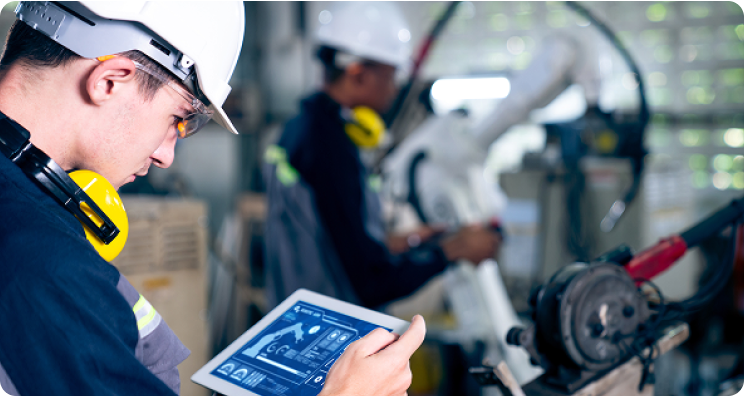
At MD&M West 2026, one theme rose above the noise: AI in manufacturing is no longer experimental. It is becoming infrastructure.
Across quality, automation, maintenance, and regulatory systems, leading manufacturers are moving past isolated proofs-of-concept and toward AI-native, IIoT-enabled operating platforms. The conversation has shifted from "Should we explore AI?" to "How do we engineer it into our operations?"
At Solvative, we see this shift as both a warning and an opportunity. Organizations that treat AI as a feature will struggle to scale. Those that engineer it as a core part of their digital foundation will define what manufacturing looks like in the next decade.
Here are the five most important signals from this year's show and how we're helping manufacturers act on them.
Manufacturers are now embedding AI directly into MES, QMS, and production systems; often through natural-language interfaces and contextual copilots that reason over production, quality, and supply data in real time.
This is not about adding a layer of analytics. It is about rethinking how decisions get made on the floor.
We design IIoT-enabled production architectures with unified data models across MES, ERP, QMS, and sensor networks. Our AI layers operate on governed manufacturing data, with embedded copilots built for operators, engineers, and managers — not just analysts. The result is AI that improves throughput and compliance, not just reporting.
AI-powered visual inspection has matured into one of the most defensible and measurable use cases in industrial AI. The shift is moving decisively toward edge inference, low-label training, and seamless integration with legacy vision systems making it accessible at scale, not just in greenfield environments.
We build edge and cloud inspection pipelines with real-time defect classification, integrated directly with SPC, CAPA, and traceability platforms. For regulated environments, we include AI audit trails designed to hold up under scrutiny. The outcome is concrete: reduced scrap, automated compliance evidence, and shorter validation cycles.
Autonomous and semi-autonomous agent systems are gaining significant attention on the show floor, but with a clear-eyed acknowledgment of operational risk. Manufacturers want workflow automation, exception handling, and closed-loop optimization. What they do not want is an uncontrolled decision engine running inside a critical production environment.
That distinction matters enormously. We implement bounded agent architectures with human-in-the-loop controls, policy-driven automation, and observability and rollback frameworks. The goal is to let AI accelerate operations without undermining governance and to make sure your team always knows what the system is doing and why.
Digital twins have evolved well beyond simulation. When combined with AI and IIoT, they are becoming live optimization systems that support predictive maintenance, energy optimization, capacity planning, and sustainability reporting in a single integrated view.
We deliver asset and process digital twins with sensor-to-model pipelines, AI forecasting layers, and integration with EAM and CMMS platforms. This turns operational data into forward-looking intelligence that teams can actually act on.
For medical device and regulated manufacturing environments, GenAI governance is rapidly becoming as foundational as cybersecurity. The key concerns are model validation, data lineage, auditability, and regulatory defensibility.
We engineer AI governance frameworks with validation workflows, documentation automation, and compliance-ready data pipelines, so that the speed of innovation does not come at the expense of regulatory risk.
MD&M West 2026 made one thing unmistakably clear: the next generation of manufacturing leaders will be platform builders.
Winning organizations are creating integrated IIoT foundations, governed data layers, embedded AI services, and secure, extensible architectures. They are not running AI experiments in silos. They are building systems.
At Solvative, this is exactly where we operate; helping manufacturers move from disconnected pilots to enterprise-grade AI that scales, governs, and sustains.
There is also an issue the industry needs to talk more openly about: model deprecation. When AI is embedded directly into production systems, a deprecated model is not only a technical inconvenience but also an operational and compliance risk, and we are actively building to address this challenge.
For New Projects
For SolverCare
Become a Solver
Or Call Us Directly at


